Education

[wpseo_breadcrumb]

Education

Khulisa is committed to promoting accountability and advancement in global education and development by measuring progress accurately. Khulisa focuses on participatory and social justice agendas, recognizing and enabling participants and evaluators to bring their own experiences, perspectives, and characteristics to the evaluation process. With 30 years’ experience working throughout the developing world, we understand the challenges and opportunities of performing complex evaluations in fragile, low- to middle-income countries that contribute to transforming education policy and practice.

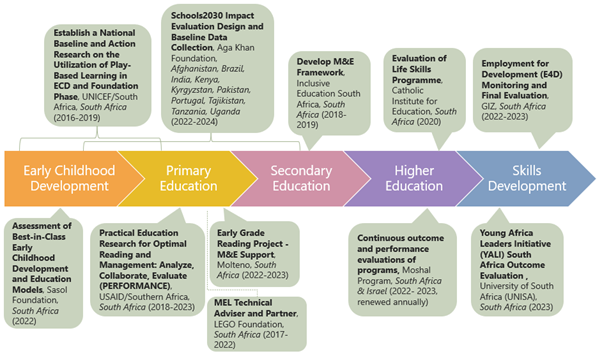
Khulisa has been evaluating education programs across the spectrum of education sectors, from early childhood development to youth skills development, since 1993, specializing in providing evaluation, research, capacity building, technical assistance, and systems strengthening services in the public and private sectors. Our work promotes evidence-based programmatic decisions and policy inputs, while simultaneously building monitoring and evaluation (M&E) capacity. We have successfully collaborated with clients to develop impact evaluation strategies and M&E frameworks and with country-based partners to ensure that data collection and reporting feeds into global measurements, such as generating evidence of the achievement of Sustainable Development Goal (SDG) 4, and reporting requirements for multi-nationals, Foundations, local and international governments, and service delivery implementers.

Khulisa’s work has contributed to the following initiatives, among others:

  • Setting early grade reading benchmarks for African languages;
  • Enhancing teacher professional development in pedagogies;
  • Improving literacy and numeracy teaching practices through higher education institutions;
  • Collecting and analyzing longitudinal data to determine the impact of interventions on learner outcomes;
  • Designing and implementing global baseline and impact studies across ten countries;
  • Developing monitoring and assessment tools and supporting capacity initiatives to strengthen implementation and utilization;
  • Evaluating and designing a cost-effective, best-in-class early grade education intervention;
  • Providing data analysis to improve tertiary education bursary andacademic results, and youth skills development; and
  • Developing evaluative frameworks and systems, including for scaling educational interventions that work in complex and challenging educational systems.

Khulisa’s Education Sector Experience

Although education has improved over the last few decades in Africa, the challenges are still immense. Approximately 40% of Africans over the age of 15, and 50% of women above the age of 25 remain illiterate. According to the UN, almost half of African countries may not attain the Millennium Challenge goal of universal primary education by 2015, with nearly 40 million children not attending school.

Early childhood development and secondary/vocational education is, in most countries, inaccessible to the majority of children. Thus, access continues to be a problem, compounded by poor quality provision, and inefficient systems.

From 2009 to 2015, Khulisa assessed more than 2500 primary, secondary and vocational schools in South Africa, Tanzania and Zambia. Our visits have given us insight into educational access, best practices, data quality and psychosocial the available resources to teachers.

Khulisa entry point into the South African development space has been through education. Our expertise in this field spans 22 years and we utilise numerous methodologies, tailored to suit the type of project, context and within fiscal, political and time constraints.